 |
| NATO |
Showing posts with label cold war. Show all posts
Showing posts with label cold war. Show all posts
Wednesday, July 12, 2023


Thursday, March 17, 2022
№ 624. The Tale of Two Cities: Moscow and Beijing
 |
| South China Morning Post |
The term “dictator” comes from ancient Rome — a man whom the republic would temporarily give absolute authority during crises. The advantages of untrammeled power in a crisis are obvious. A dictator can act quickly — no need to spend months negotiating legislation or fighting legal challenges. And he can impose necessary but unpopular policies. So there are times when autocratic rule can look more effective than the messiness of democracies bound by rule of law.
Dictatorship, however, starts to look a lot less attractive if it continues for any length of time.
The most important argument against autocracy is, of course, moral: Very few people can hold unrestrained power for years on end without turning into brutal tyrants.
Beyond that, however, in the long run autocracy is less effective than an open society that allows dissent and debate. As I wrote a couple of weeks ago, the advantages of having a strongman who can tell everyone what to do are more than offset by the absence of free discussion and independent thought.
I was writing at the time about Vladimir Putin, whose decision to invade a neighboring country looks more disastrous with each passing day. Evidently nobody dared to tell him that Russia’s military might was overrated, that Ukrainians were more patriotic and the West less decadent than he assumed and that Russia remained highly vulnerable to economic sanctions.
But while we’re all justifiably obsessed with the Ukraine war — I’m trying to limit my reading of Ukraine news to 13 hours a day — it’s important to note that there’s a superficially very different yet in a deep sense related debacle unfolding in the world’s other big autocracy: China, which is now experiencing a disastrous failure of its Covid policy.
Wednesday, March 2, 2022
№ 620. Cold War 2.0 (Part 2): The Fog of War
 |
| The Oriental Review |
The fog of war
Early evidence suggests that this war is turning in the West’s favor for three reasons. The raw aggression of the Russian invasion and the spirited Ukrainian resistance have inspired popular support for Ukraine across Europe. Russia and Putin appear to have badly underestimated both Ukraine’s determination and the global outrage against Moscow. Finally, democratic governments on both sides of the Atlantic have made far-reaching policy choices—economic, financial, diplomatic, and security—that reflect a boldness of purpose and a newfound solidarity.
Yet the world remains in a dangerous and highly uncertain moment. What happens after this conflict is as much a question mark as how, when, and where the fighting ends. These four scenarios reflect plausible outcomes—but they hardly exhaust all possibilities. Putin could end up strengthened or weakened within Russia, depending on domestic developments (a popular uprising or coup) and external ones (China bolstering or reducing its support for Putin himself). He could make a play for Moldova or Georgia, or even attempt to take the Suwalki gap between Russia’s Baltic enclave of Kaliningrad and Belarus.
Wars, once begun, rarely follow a script. More frequently, they lead combatants and non-combatants alike down unanticipated pathways, with occasionally world-changing results. Russia’s invasion of Ukraine appears to have the seeds of such a conflict. What its outcome will mean for Ukraine and the world remains to be seen.
MEANWHILE.....

Wednesday, February 23, 2022
№ 619. Cold War 2.0
 |
| This cartoon was published by John Collins to show the stark ideological differences between the two superpowers. |
Mr. Putin’s revisionist and absurd assertion that Ukraine was “entirely created by Russia” and effectively robbed from the Russian empire is fully in keeping with his warped worldview. Most disturbing to me: It was his attempt to establish the pretext for a full-scale invasion.
Should he invade, it will be a historic error.
In the 20-odd years since we met, Mr. Putin has charted his course by ditching democratic development for Stalin’s playbook. He has collected political and economic power for himself — co-opting or crushing potential competition — while pushing to re-establish a sphere of Russian dominance through parts of the former Soviet Union. Like other authoritarians, he equates his own well-being with that of the nation and opposition with treason. He is sure that Americans mirror both his cynicism and his lust for power and that in a world where everyone lies, he is under no obligation to tell the truth. Because he believes that the United States dominates its own region by force, he thinks Russia has the same right.
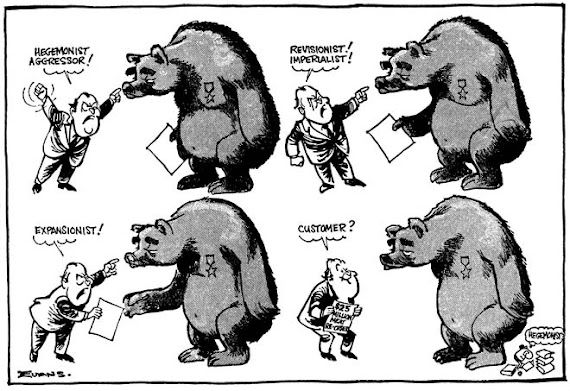
Mr. Putin has for years sought to burnish his country’s international reputation, expand Russia’s military and economic might, weaken NATO and divide Europe (while driving a wedge between it and the United States). Ukraine features in all of that.Instead of paving Russia’s path to greatness, invading Ukraine would ensure Mr. Putin’s infamy by leaving his country diplomatically isolated, economically crippled and strategically vulnerable in the face of a stronger, more united Western alliance.
.......................................................................................................................................................................
Meanwhile, the great dragon of the East watches with interest. It's wide-awake and has been flexing its wings towards the Pacific.
 |
| Great Wall |
Subscribe to:
Comments (Atom)