Showing posts with label covid. Show all posts

Tuesday, October 3, 2023

№ 694. Science v. The 2020 Pandemic

NPR


Dr. Karikó, the 13th woman to win the prize, languished for many long years without funding or a permanent academic position, keeping her research afloat only by latching on to more senior scientists at the University of Pennsylvania who let her work with them. Unable to get a grant, she said she was told she was “not faculty quality” and was forced to retire from the university a decade ago. She remains only an adjunct professor there while she pursues plans to start a company with her daughter, Susan Francia, who has an M.B.A. and was a two-time Olympic gold medalist in rowing.

The mRNA work was especially frustrating, she said, because it was met with indifference and a lack of funds. She said she was motivated by more than not being called a quitter; as the work progressed, she saw small signs that her project could lead to better vaccines. “You don’t persevere and repeat and repeat just to say, ‘I am not giving up,’” she said.

Thursday, March 17, 2022

№ 624. The Tale of Two Cities: Moscow and Beijing

South China Morning Post


The term “dictator” comes from ancient Rome — a man whom the republic would temporarily give absolute authority during crises. The advantages of untrammeled power in a crisis are obvious. A dictator can act quickly — no need to spend months negotiating legislation or fighting legal challenges. And he can impose necessary but unpopular policies. So there are times when autocratic rule can look more effective than the messiness of democracies bound by rule of law.

Dictatorship, however, starts to look a lot less attractive if it continues for any length of time.

The most important argument against autocracy is, of course, moral: Very few people can hold unrestrained power for years on end without turning into brutal tyrants.

Beyond that, however, in the long run autocracy is less effective than an open society that allows dissent and debate. As I wrote a couple of weeks ago, the advantages of having a strongman who can tell everyone what to do are more than offset by the absence of free discussion and independent thought.

I was writing at the time about Vladimir Putin, whose decision to invade a neighboring country looks more disastrous with each passing day. Evidently nobody dared to tell him that Russia’s military might was overrated, that Ukrainians were more patriotic and the West less decadent than he assumed and that Russia remained highly vulnerable to economic sanctions.

But while we’re all justifiably obsessed with the Ukraine war — I’m trying to limit my reading of Ukraine news to 13 hours a day — it’s important to note that there’s a superficially very different yet in a deep sense related debacle unfolding in the world’s other big autocracy: China, which is now experiencing a disastrous failure of its Covid policy.


Thursday, September 2, 2021

№ 582. The Snake Oil Theory of the Modern Right

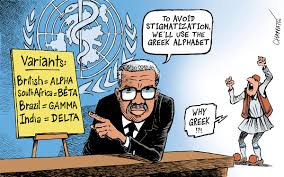
Consider where we are right now in the fight against Covid-19. A few months ago it seemed likely that the development of effective vaccines would soon bring the pandemic to an end. Instead, it goes on, with hospitalizations closing in on their peak from last winter. This is partly due to the emergence of the highly contagious Delta variant, but it also crucially reflects the refusal of many Americans to take the vaccines.

And much of this refusal is political. True, many people who are refusing to get vaccinated aren’t Trumpists, but there’s a strong negative correlation between Donald Trump’s share of a county’s vote and vaccinations. As of July, 86 percent of self-identified Democrats said they had had a vaccine shot, but only 54 percent of Republicans did.

But vaccine refusers aren’t just rejecting lifesaving vaccines, they’re also turning to life-threatening alternatives. We’re seeing a surge in sales of — and poisoning by — ivermectin, which is usually used to deworm livestock but has recently been touted on social media and Fox News as a Covid cure.

Sunday, August 22, 2021

№ 579. Ivermectin

The Scientist


Ivermectin, an anti-parasitic drug commonly used for livestock, should not be taken to treat or prevent Covid-19, the Food and Drug Administration said on Saturday.

The warning came a day after the Mississippi State Department of Health issued a similar statement in response to reports that an increasing number of people in Mississippi were using the drug to prevent a Covid infection.
 
Ivermectin, which is also formulated for use by people to treat parasitic worms, had been controversially promoted as a potential Covid treatment earlier in the pandemic, but recent studies found that the drug’s efficacy against the coronavirus is thin, and the F.D.A. has not approved the drug for Covid treatment.
 
Some of the symptoms associated with Ivermectin toxicity include rash, nausea, vomiting, abdominal pain, neurological disorders and potentially severe hepatitis that could require hospitalization, Mississippi health officials said.

Sunday, July 4, 2021

№ 574. V for Vaccines 3

 The 3 Simple Rules That Underscore the Danger of Delta:
 

1. The vaccines are still beating the variants.
2. The variants are pummeling unvaccinated people.
3. The longer Principle No. 2 continues, the less likely No. 1 will hold.

Twitter.com

Thursday, June 17, 2021

№ 572. The Endgame: How Will the Pandemic End?

This is a long read, written in March 2020 at the beginning of the pandemic just after the borders were closed. Quite prophetic.

Three endgames:

1. One that’s very unlikely;

2. One that’s very dangerous; and, 

3. One that’s very long.


Wednesday, April 21, 2021

№ 568. Manila Extract 3 (NCR+)

Scout Mag

You're Old Testament.
A prophecy of unsealed
memes and fake news.

You are red-tagged.
A metastasis
hooked on ether.
 
You are Manila.
Hangry for cures
sniffed from dystopia.


Sunday, January 31, 2021

№ 548. Social Connections and Our Well-Being

Text from The Atlantic


Marketoonist

The psychological effects of losing all but our closest ties can be profound. Peripheral connections tether us to the world at large; without them, people sink into the compounding sameness of closed networks. Regular interaction with people outside our inner circle “just makes us feel more like part of a community, or part of something bigger,”.... People on the peripheries of our lives introduce us to new ideas, new information, new opportunities, and other new people. 
 
If variety is the spice of life, these relationships are the conduit for it.

The loss of these interactions may be one reason for the growth in internet conspiracy theories in the past year, and especially for the surge in groups like QAnon. But while online communities of all kinds can deliver some of the psychological benefits of meeting new people and making friends in the real world, the echo chamber of conspiracism is a further source of isolation. “There’s a lot of research showing that when you talk only to people who are like you, it actually makes your opinions shift even further away from other groups,”.... 
 
“That’s how cults work. That’s how terrorist groups work.”

The physical ramifications of isolation are also well documented.... social isolation increases the risk of premature death from any cause by almost 30 percent. “The scientific evidence suggests that we need a variety of kinds of relationships in our lives, and that different kinds of relationships or social roles can fulfill different kinds of needs,”.... People maintain hygiene, take their medication, and try to hold themselves together at least in part because those behaviors are socially necessary, and their repetition is rewarded. Remove those incentives, and some people fall into despair, unable to perform some of the crucial tasks of being alive. In people at risk for illness, lack of interaction can mean that symptoms go unnoticed and arrangements for medical care aren’t made. Humans are meant to be with one another, and when we aren’t, the decay shows in our bodies.

Saturday, January 30, 2021

№ 546. Not All Masks Are Created Equal

Is there a hierarchy of masks?
 

A new study in Duke University ranked 14 types of commonly available masks, finding that medical masks offer significantly more protection against droplet spread than cotton alternatives – while bandanas protect less, and neck fleeces don’t do much at all.
 

The study revealed that different masks eliminated droplet spray by the following percentages, from the best to worst:

  1. N95 - 99.9%
  2. Surgical or polypropylene masks - 90%
  3. Cotton face coverings - 70% to 90%
  4. Bandanas - 50%

Neck fleeces, meanwhile, were found to expel more droplets than with no mask at all, probably by dispersing the largest droplets into many smaller droplets.

"The notion that 'anything is better than nothing' didn't hold true," said Eric Westman, one of the study's co-authors.