 |
| NPR |
Showing posts with label science. Show all posts
Showing posts with label science. Show all posts
Wednesday, June 25, 2025


Monday, April 7, 2025
Wednesday, March 19, 2025

Tuesday, December 17, 2024

Monday, December 9, 2024
№ 769. Waking Up to Non-Binary Dreams 7
 |
| Online Academic Community |
It measures just 4cm squared but it possesses almost inconceivable speed.
Google has built a computing chip that takes just five minutes to complete tasks that would take 10,000,000,000,000,000,000,000,000 years for some of the world’s fastest conventional computers to complete.
That’s 10 septillion years, a number that far exceeds the age of our known universe and has the scientists behind the latest quantum computing breakthrough reaching for a distinctly non-technical term: “mindboggling”.
The new chip, called Willow and made in the California beach town of Santa Barbara, is about the dimensions of an After Eight mint, and could supercharge the creation of new drugs by greatly speeding up the experimental phase of development.
Reports of its performance follow a flurry of results since 2021 that suggest we are only about five years away from quantum computing becoming powerful enough to start transforming humankind’s capabilities to research and develop new materials from drugs to batteries, one independent UK expert said. Governments around the world are pouring tens of billions of dollars into research.
Significantly, Willow is claimed to be far less prone to error than previous versions and could swell the potential of the already fast-developing field of artificial intelligence.
Quantum computing – which harnesses the discovery that matter can exist in multiple states at once – is predicted to have the power to carry out far bigger calculations than previously possible and so hasten the creation of nuclear fusion reactors and accelerate the impact of artificial intelligence, notably in medical science. For example, it could allow MRI scans to be read in atom-level detail, unlocking new caches of data about human bodies and disease for AI to process, Google said.

BENTO BOX - Added April 10, 2025
“April 6, 2025Keanu Reeves is known not only for his iconic film roles, but also for his wisdom, humility, and deep understanding of human existence. In a compelling live debate watched by millions of viewers worldwide, he caught none other than Elon Musk, the visionary and tech mogul, to talk about one of the most pressing issues of our time: the future of artificial intelligence, creativity and human connection.
The tension was palpable when the two men faced each other. Elon Musk, known for his bold visions of Mars colonies and an AI-powered future, spoke about the need for technological advancements to save humanity. Reeves, on the other hand, introduced a calmer, more contemplative perspective: “Perhaps our goal is not to control the world, but to understand it.”
The moment that Elon got mute.
The studio was quiet.
The meeting of opposites.
The tension was palpable when the two men faced each other. Elon Musk, known for his bold visions of Mars colonies and an AI-powered future, spoke about the need for technological advancements to save humanity. Reeves, on the other hand, introduced a calmer, more contemplative perspective: “Perhaps our goal is not to control the world, but to understand it.”
The moment that Elon got mute.
When asked whether AI will surpass human creativity, Elon Musk responded with a clear: “Sooner or later, yes. Machines will create art, compose music and tell stories – better than us. ”
The camera waved at Keanu Reeves, who briefly remained silent, then took a deep breath and said: “But will a machine ever know what it feels like to miss something? Or what is it like to create something beautiful out of a moment of sorrow? Creativity does not arise from calculation but from experience, pain, love, and hope.”
The studio was quiet.
Even Musk seemed speechless for a moment.
This sentence, simple and profound at the same time, sounded far beyond the screen. The scene spread rapidly on social media. “Reeves has not only silenced the room but also redefined our understanding of humanity,” commented one viewer on X. Philosophers, artists and scientists spoke up and praised Keanu's point of view as a urgently needed reminder that progress must be measured not only in data, but also in feeling. In a world increasingly lost in technology, Keanu Reeves reminded us that our deepest values cannot be programmed.
What makes us human is not our efficiency, but our imperfection.
And sometimes all it takes is a simple, honest sentence to make a whole room think - even if Elon Musk is sitting in it.”
Daniel Gugger 888
@daniel_gugger 8. April 2025
on X
@daniel_gugger 8. April 2025
on X
Monday, August 12, 2024
№ 747. Carl Sagan & Science
“Science is more than a body of knowledge.
It is a way of thinking; a way of skeptically interrogating the universe with a fine understanding of human fallibility. If we are not able to ask skeptical questions, to interrogate those who tell us that something is true, to be skeptical of those in authority, then, we are up for grabs for the next charlatan (political or religious) who comes rambling along.”
― Carl Sagan
Note Bene:
 |
| I think about them, therefore, they exist. |
Tuesday, October 3, 2023
№ 694. Science v. The 2020 Pandemic

Dr. Karikó, the 13th woman to win the prize, languished for many long years without funding or a permanent academic position, keeping her research afloat only by latching on to more senior scientists at the University of Pennsylvania who let her work with them. Unable to get a grant, she said she was told she was “not faculty quality” and was forced to retire from the university a decade ago. She remains only an adjunct professor there while she pursues plans to start a company with her daughter, Susan Francia, who has an M.B.A. and was a two-time Olympic gold medalist in rowing.
The mRNA work was especially frustrating, she said, because it was met with indifference and a lack of funds. She said she was motivated by more than not being called a quitter; as the work progressed, she saw small signs that her project could lead to better vaccines. “You don’t persevere and repeat and repeat just to say, ‘I am not giving up,’” she said.
Wednesday, April 26, 2023

Monday, April 24, 2023

Thursday, March 23, 2023
№ 677. Faith Inspiring Science
 |
| Ohio State University |
All three work or worked in the Specola Vaticana, or Vatican Observatory, just off the papal gardens at Castel Gandolfo, a short drive from Rome. The observatory is a descendant of centuries of Vatican-sponsored research into the stars, and it is the only Vatican body that carries out scientific study.
The history of the observatory, which has been staffed by Jesuits since the 1930s, is a rebuttal to the notion that the Roman Catholic Church has always sought to stand in the way of scientific advancement, an idea perpetuated by high-profile cases like those of Galileo and Giordano Bruno at the hands of the Inquisition during the Renaissance.
Thursday, October 27, 2022
№ 655. Climate Status

You can never really see the future, only imagine it, then try to make sense of the new world when it arrives.
Just a few years ago, climate projections for this century looked quite apocalyptic, with most scientists warning that continuing “business as usual” would bring the world four or even five degrees Celsius of warming — a change disruptive enough to call forth not only predictions of food crises and heat stress, state conflict and economic strife, but, from some corners, warnings of civilizational collapse and even a sort of human endgame. (Perhaps you’ve had nightmares about each of these and seen premonitions of them in your newsfeed.)
Now, with the world already 1.2 degrees hotter, scientists believe that warming this century will most likely fall between two or three degrees. (A United Nations report released this week ahead of the COP27 climate conference in Sharm el Sheikh, Egypt, confirmed that range.) A little lower is possible, with much more concerted action; a little higher, too, with slower action and bad climate luck. Those numbers may sound abstract, but what they suggest is this: Thanks to astonishing declines in the price of renewables, a truly global political mobilization, a clearer picture of the energy future and serious policy focus from world leaders, we have cut expected warming almost in half in just five years.
Tuesday, July 12, 2022
№ 640. Scientific Method
This section was lifted from one of my favorite textbooks in college. Paul G. Hewitt made Physics interesting, accessible, clear and entertaining. I still have a copy of my textbooks (two volumes!), which are now older than a teenager. Not all books are written equal. Quite a few are outstanding. This one lit fire in our heads.
 |
| Conceptual Physics by Paul G. Hewitt |
Monday, July 11, 2022
№ 639. Cosmos: Webb v Hubble
 |
| A Technological Marvel |
How does the Webb compare with the Hubble telescope?
The Webb telescope’s primary mirror is 6.5 meters in diameter, compared with Hubble’s, which is 2.4 meters, giving Webb about seven times as much light-gathering capability and thus the ability to see further out in space and so deeper into the past.
Tuesday, February 8, 2022
№ 618. Science & Reality
 |
| Erik Petri |
In Labatut’s telling, Heisenberg then comes to recognize that the parameters of any given quantum object can never be identified with certainty. If the position of an electron is determined precisely, “arresting that particle in its orbit like an insect impaled on a pin,” then it becomes impossible to know its momentum, and vice versa. The variables are mathematically complementary, so that the more clearly we bring one into focus, the more it blurs our understanding of the other — as if, Heisenberg explains, “reality allowed us to perceive the world with crystalline clarity with one eye at a time, but never with both.”
With his slippery hybrid of fact and fiction, Labatut slyly applies the uncertainty principle to the human pursuit of knowledge itself. Abstraction and imagination, measurement and story coexist in a multidimensional reality containing infinite destinies and interpretations. At its furthest reaches, reason and scientific inquiry lead into the unknowable. As Labatut puts it, in words he ascribes to Schwarzschild: “Only a vision of the whole, like that of a saint, a madman or a mystic, will permit us to decipher the true organizing principles of the universe.”
Sunday, October 3, 2021

Monday, August 30, 2021

Sunday, August 22, 2021
№ 579. Ivermectin

Ivermectin, an anti-parasitic drug commonly used for livestock, should not be taken to treat or prevent Covid-19, the Food and Drug Administration said on Saturday.
The warning came a day after the Mississippi State Department of Health issued a similar statement in response to reports that an increasing number of people in Mississippi were using the drug to prevent a Covid infection.
Ivermectin, which is also formulated for use by people to treat parasitic worms, had been controversially promoted as a potential Covid treatment earlier in the pandemic, but recent studies found that the drug’s efficacy against the coronavirus is thin, and the F.D.A. has not approved the drug for Covid treatment.
Some of the symptoms associated with Ivermectin toxicity include rash, nausea, vomiting, abdominal pain, neurological disorders and potentially severe hepatitis that could require hospitalization, Mississippi health officials said.
Sunday, July 4, 2021
№ 574. V for Vaccines 3
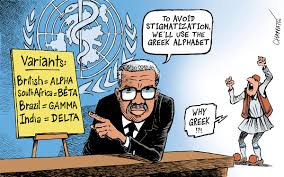
The 3 Simple Rules That Underscore the Danger of Delta:
1. The vaccines are still beating the variants.
2. The variants are pummeling unvaccinated people.
3. The longer Principle No. 2 continues, the less likely No. 1 will hold.
 |
| Twitter.com |
Tuesday, June 22, 2021


Thursday, June 17, 2021
№ 572. The Endgame: How Will the Pandemic End?
This is a long read, written in March 2020 at the beginning of the pandemic just after the borders were closed. Quite prophetic.
Three endgames:
1. One that’s very unlikely;
2. One that’s very dangerous; and,
3. One that’s very long.

Subscribe to:
Posts (Atom)