Showing posts with label Pandemics. Show all posts

Sunday, July 4, 2021

№ 574. V for Vaccines 3

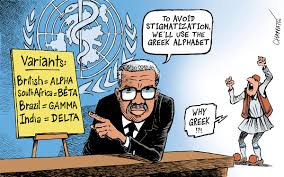
 The 3 Simple Rules That Underscore the Danger of Delta:
 

1. The vaccines are still beating the variants.
2. The variants are pummeling unvaccinated people.
3. The longer Principle No. 2 continues, the less likely No. 1 will hold.
Twitter.com

Sunday, January 31, 2021

№ 548. Social Connections and Our Well-Being

Text from The Atlantic


Marketoonist

The psychological effects of losing all but our closest ties can be profound. Peripheral connections tether us to the world at large; without them, people sink into the compounding sameness of closed networks. Regular interaction with people outside our inner circle “just makes us feel more like part of a community, or part of something bigger,”.... People on the peripheries of our lives introduce us to new ideas, new information, new opportunities, and other new people. 
 
If variety is the spice of life, these relationships are the conduit for it.

The loss of these interactions may be one reason for the growth in internet conspiracy theories in the past year, and especially for the surge in groups like QAnon. But while online communities of all kinds can deliver some of the psychological benefits of meeting new people and making friends in the real world, the echo chamber of conspiracism is a further source of isolation. “There’s a lot of research showing that when you talk only to people who are like you, it actually makes your opinions shift even further away from other groups,”.... 
 
“That’s how cults work. That’s how terrorist groups work.”

The physical ramifications of isolation are also well documented.... social isolation increases the risk of premature death from any cause by almost 30 percent. “The scientific evidence suggests that we need a variety of kinds of relationships in our lives, and that different kinds of relationships or social roles can fulfill different kinds of needs,”.... People maintain hygiene, take their medication, and try to hold themselves together at least in part because those behaviors are socially necessary, and their repetition is rewarded. Remove those incentives, and some people fall into despair, unable to perform some of the crucial tasks of being alive. In people at risk for illness, lack of interaction can mean that symptoms go unnoticed and arrangements for medical care aren’t made. Humans are meant to be with one another, and when we aren’t, the decay shows in our bodies.

Saturday, January 30, 2021

№ 546. Not All Masks Are Created Equal

Is there a hierarchy of masks?
 

A new study in Duke University ranked 14 types of commonly available masks, finding that medical masks offer significantly more protection against droplet spread than cotton alternatives – while bandanas protect less, and neck fleeces don’t do much at all.
 

The study revealed that different masks eliminated droplet spray by the following percentages, from the best to worst:

  1. N95 - 99.9%
  2. Surgical or polypropylene masks - 90%
  3. Cotton face coverings - 70% to 90%
  4. Bandanas - 50%

Neck fleeces, meanwhile, were found to expel more droplets than with no mask at all, probably by dispersing the largest droplets into many smaller droplets.

"The notion that 'anything is better than nothing' didn't hold true," said Eric Westman, one of the study's co-authors.


Wednesday, September 16, 2020

№ 511. Zombie Preparedness. Since 2018.


The CDC, yes, the U.S. Centers for Disease Control and Prevention has a Zombie Preparedness page. 

For real. 

Its says:

"So what do you need to do before zombies…or hurricanes or pandemics for example, actually happen? First of all, you should have an emergency kit in your house. This includes things like water, food, and other supplies to get you through the first couple of days before you can locate a zombie-free refugee camp (or in the event of a natural disaster, it will buy you some time until you are able to make your way to an evacuation shelter or utility lines are restored). Below are a few items you should include in your kit, for a full list visit the CDC Emergency page.

  • Water (1 gallon per person per day)
  • Food (stock up on non-perishable items that you eat regularly)
  • Medications (this includes prescription and non-prescription meds)
  • Tools and Supplies (utility knife, duct tape, battery powered radio, etc.)
  • Sanitation and Hygiene (household bleach, soap, towels, etc.)
  • Clothing and Bedding (a change of clothes for each family member and blankets)
  • Important documents (copies of your driver’s license, passport, and birth certificate to name a few)
  • First Aid supplies (although you’re a goner if a zombie bites you, you can use these supplies to treat basic cuts and lacerations that you might get during a tornado or hurricane)."


Tuesday, September 8, 2020

№ 508. The Paradoxes of Enclosure


At a time when the rule of life across the globe has been disrupted by the paradoxes of collective isolation, a sensitivity to “the small,” to containment and enclosure, presses upon individuals, families, and society in unexpected and often confounding ways. Like Jones’s experimental letter forms, we awkwardly jostle for space within the confines of our homes, balconies, and gardens. Even communal spaces like parks and grocery stores seem to have shrunk, as attempts to heed social distancing alter our awareness of space. Our sense of what counts as crowded has changed, as we learn to accommodate these new rules. Meanwhile, many of us, particularly those in self-isolation, are simultaneously learning just how vastly vacant even a small space can feel.

We can recalibrate our senses to the mysteries of the small through meditation on that paradox of paradoxes, the Incarnation, with the help of this little wood block by David Jones. Throughout Jones’s work there is a marked affection for “things familiar and small.” It is inseparable from a spiritual practice of attention—tuning our senses to that which is easily overlooked or undervalued. Wrapped up in this sensitivity to the small is a care for the fragile, the vulnerable, and a discovery of the surprising resilience of the delicate. It is guided above all by the conviction that it is through refinement of our attention that the wonder and mystery of the created world, particularly in its relation to the divine, reveals itself most fully to us. Focusing on what is small and seemingly commonplace becomes a portal for seeing all things in light of the love of God and thus yields, paradoxically, the most generous and capacious of vantage points.


As the whole world fights to contain a contagion through the mantra “stay at home,” uniting and separating lives in various ways, our spiritual labor in this time may be to find these openings for grace within the multiple circles of our everyday circumstance as these widen and intersect with others, and in light of their relation to the divine Other. We are in truth, as Julian of Norwich reminds us, enclosed not by walls or government guidelines, but by the enduring intimacy of the love of God. For “he is our clothing that for love wrappeth us and windeth us, holdeth us and all becloseth us, hangeth about us for tender love that he may never leave us.”


Grand Mosque at Djenne, Mali


Sunday, May 31, 2020

№ 473. Vitamin S (Science)

Taiwan scientists find antibody that fights coronavirus.

BUT...

As many experts have reminded us, it will take about 12-18 months AT BEST to have a vaccine. 

Many viral diseases like polio, flu, chicken pox, hepatitis, etc. took many years, even decades, to manage with an effective and affordable vaccine. We will have to put in a community of resources --- time, scientists, governments, funds, cooperation and goodwill, etc. --- to invent another "miracle" of science. 

We need unity in diversity.

AND...

To be philosophical about this collective pandemic experience, it makes me appreciate how wonderful it is to be alive and how truly worth saving humanity is. Because what is the other path? Death? Despair? Descent into chaos?

Thursday, May 21, 2020

№ 469. The White Plague in La Traviata

Hold Your Breath

In La Traviata, Violetta was stricken with tuberculosis, also known as the White Plague or consumption. Thanks to the science of medicine, today TB is generally a curable disease. People will have to think of more dramatic causes to kill off their heroines. Covid-19?

Tuesday, April 14, 2020

№ 451. Nations of the World, Unite!

The Week


But the weakness of Washington should not prevent the brain trust of the developed world — the think tanks, news media, universities and nongovernmental organizations — from focusing on a strategy for the next and possibly most brutal front in the struggle against the scourge of the coronavirus. Many organizations have already begun to do so, recognizing that this may be the defining struggle of our era, and that if ever the world demanded a global response, this is it.

Thursday, March 26, 2020

№ 446. The Plague


Viktor Frankl, writing from the madness of the Holocaust, reminded us that we don’t get to choose our difficulties, but we do have the freedom to select our responses. Meaning, he argued, comes from three things: the work we offer in times of crisis, the love we give and our ability to display courage in the face of suffering. The menace may be subhuman or superhuman, but we all have the option of asserting our own dignity, even to the end.

Suffering can be redemptive. We learn more about ourselves in these hard periods. The differences between red and blue don’t seem as acute on the gurneys of the E.R., but the inequality in the world seems more obscene when the difference between rich and poor is life or death.

Sunday, March 22, 2020

№ 445. Covid Prescription: Dogs

Broad Sheet
 
What is it about animals? As the bad news about the coronavirus continues, “send me dogs and cats” has become a regular cry on social media, an easy-to-grasp shorthand for “I feel terrible, cheer me up”. The response is always the same: a torrent of pictures of animals doing daft things – but somehow it has a magical, calming effect.

The therapeutic value of our relationship with our pets, particularly dogs, is increasingly recognised by researchers. Cats can be wonderful too – but dogs have been domesticated by humans for much longer, and, as even the most devoted cat lover will admit, dogs are far easier to train for companionship. Most cats, as we know, are admirable for entirely different reasons. Marion Janner, a mental health campaigner and all-round animal lover, says that dogs teach us a whole range of lessons. “Dogs love us unconditionally. They’re the ultimate in equal opportunities – entirely indifferent to race, gender, star sign, CV, clothes size or ability to throw cool moves on the dance floor. The simplicity and depth of this love is a continuous joy, along with the health benefits of daily walks and the social delights of chats with other dog walkers. They teach kids to be responsible, altruistic and compassionate and, valuably but sadly, how to cope when someone you love dies.”

Friday, March 20, 2020

№ 444. Virtual Tours in the Age of Covid

Max Gustafson


Here's a safer and cheaper way to travel while the world is on quarantine: virtual tours.

Soon, I think, we can reinvent the internet and involve the other senses in the virtual tours. For example, we can walk through the tour and touch the exhibits, if allowed. Or smell and taste them, if the curators want us to sample them.

Fast forward to science fiction reality about a hundred years from now. After this 2020 pandemic becomes an uneventful entry in history, I look forward to teleporting directly to any tourist attraction, museum, restaurant, concert on the planet or off.

Teleporting will dispense with a lot of the necessary inconveniences of travel in the present like check-in, immigration, pre-departure wait and baggage carousels. Viruses and other contaminants, like terrorists, can also be safely isolated in the ether before they reach their destinations. Some thought.

Wednesday, February 19, 2020

№ 440. The Pandemic of Xenophobia and Scapegoating


Societies facing novel pathogens have often engaged in scapegoating of marginalized populations, especially when the infective source can be linked to a distant place and the disease associated with a racially distinct “foreign” peoples. During the nineteenth century, rather than curtail commercial shipping, which ferried cholera around the globe, rattled cholera-stricken societies from New York to London turned their ire onto Irish immigrants instead. In 1832, a group of Irish immigrants, irrationally scorned as carriers, were first quarantined, and then secretly massacred and buried in a mass grave. Erroneously blamed for spreading HIV in the early 1980s, Haitians were beaten and harassed. Falsely scapegoated as carriers of SARS in 2003, Canadians of Chinese descent were kicked out of their homes and their businesses avoided.

Monday, February 3, 2020

№ 438. The Dark Side of Globalization: Pandemics 2

If we put the Novel Coronavirus in context, we help guard against irrational fears, biases, panics and prejudices. 


Outbreak
Globalization, the flow of information, goods, capital, and people across political and geographic boundaries, allows infectious diseases to rapidly spread around the world, while also allowing the alleviation of factors such as hunger and poverty, which are key determinants of global health.The spread of diseases across wide geographic scales has increased through history. Early diseases that spread from Asia to Europe were bubonic plague, influenza of various types, and similar infectious diseases.

In the current era of globalization, the world is more interdependent than at any other time. Efficient and inexpensive transportation has left few places inaccessible, and increased global trade in agricultural products has brought more and more people into contact with animal diseases that have subsequently jumped species barriers (see zoonosis).

Saturday, February 1, 2020

№ 437. The Dark Side of Globalization: Pandemics

All about the Novel Coronavirus

How contagious is the virus?
It seems moderately infectious, similar to SARS.

How deadly is the virus?
It’s hard to know yet. But the fatality rate is probably less than 3 percent, much less than SARS.

How long does it take to show symptoms?
Possibly between 2 to 14 days, allowing the illness to go undetected.

How much have infected people traveled?
The virus spread quickly because it started in a transportation hub.

How effective will the response be?
The W.H.O. has praised China’s efforts, but critics fear lockdown measures may not be enough.

How long will it take to develop a vaccine?
A vaccine is still a year away — at minimum.