Showing posts with label global politics. Show all posts

Tuesday, July 14, 2026

№ 820. Space Race 2.0

Statista

On Friday, the bottom part of a rocket that had been launched just minutes earlier descended toward what looked like a stubby drilling derrick floating in the South China Sea. As the rocket stage, known as a booster, slowed almost to a stop and precisely maneuvered into the center of the structure, a grid of wires gently closed around it.

It was a remarkable success for a Chinese government-owned space company. On the inaugural flight of its new Long March 10B rocket, it nailed a critical step toward China’s goal of developing reusable rockets.

The wire-catching technique was also novel. By snagging the booster as it hovered above the platform, engineers eliminated the need to equip the booster with landing legs.

The milestone offered further evidence that China’s space industry, while still trailing that of the United States, may be closing the gap. Reusing rockets instead of discarding them after one launch enables a quicker pace of operation — more like jetliners — and reduces costs for the launching of satellites and other payloads.

But Todd Harrison, a senior fellow at the American Enterprise Institute, a think tank in Washington, was not overly impressed, noting that Elon Musk’s rocket company, SpaceX, first landed a booster more than 10 years ago with its Falcon 9 rocket. The Long March 10B is roughly comparable in size and capability to the Falcon 9.

“It means they are making progress,” Mr. Harrison said of the Chinese, “but not necessarily catching up to where U.S. capabilities are today.”

Thursday, February 19, 2026

№ 807. Rule of Law versus Rule of Men (Kings)


The Week


The British police on Thursday evening released Andrew Mountbatten-Windsor, formerly known as Prince Andrew, after taking him into custody for several hours, intensifying a long-running crisis for the monarchy over his ties to the convicted sex offender Jeffrey Epstein.

The detention and questioning of Mr. Mountbatten-Windsor, once seen as a dashing war hero and the favorite son of Queen Elizabeth II, was a staggering blow for the monarchy. It was the first time in modern history that a member of the British royal family had been arrested. The last time was in 1649, when Charles I was executed for treason during the English Civil War.


Reddit

Tuesday, November 4, 2025

№ 788. The Western Sea


 BATANES, Philippines - Marilyn Hubalde still remembers the first time she heard the thunderous chop of military helicopters swooping over this northernmost outpost of the Philippines, less than 90 miles from Taiwan. It was April 2023, when Filipino and American troops descended on the cluster of 10 emerald green islands of Batanes province for amphibious warfare drills

“We were terrified,” the 65-year-old Hubalde recalled. “We thought China might attack when they learned there were military exercises in Batanes.” Hubalde’s helper, who was in the fields when the troops arrived, panicked and hid in the woods until nightfall. “She thought the war had already started,” said Hubalde, who owns a variety store in the provincial capital, Basco

Since then, Batanes’ 20,000 residents have become accustomed to high-tempo war games in these islands of tightly packed towns and villages wedged between rugged slopes and stony beaches. Among them: a series of joint exercises from April to June this year in which U.S. forces twice airlifted anti-ship missile launchers here.

Until recently, locals say, this smallest and least populous province of the Philippines was a peaceful backwater. But geography dictates that it is now on the frontline of the great power competition between the United States and China for dominance in the Asia-Pacific region. The islands sit on the southern edge of the Bashi Channel, a major shipping lane between the Philippines and Taiwan that connects the South China Sea with the Western Pacific

This year’s exercises revealed how the U.S. and its Philippine ally intend to use ground-based anti-ship missiles as part of efforts to deny the Chinese navy access to the Western Pacific by making this waterway impassable in a conflict, Reuters reporting shows. These missiles could also be used to attack a Chinese fleet attempting to invade Taiwan or mount a blockade against the democratically governed island.
 
The ability to conduct operations deep into the Pacific would be vital for the Chinese navy if it wanted to counter U.S. and Japanese attempts to intervene in a Taiwan crisis. Chinese naval and air forces would also need to operate in the Western Pacific to stymie any counter-measures by the U.S. and its allies if Beijing imposed a blockade on Taiwan.
 
“We should have the ability to deny the Chinese control of the Bashi Channel,” retired Rear Admiral Rommel Ong, a former vice-commander of the Philippine Navy, told Reuters in an interview. “In a conflict scenario, that decisive point will determine who wins or who loses.”
 
Retired General Emmanuel Bautista, a former chief of staff of the Armed Forces of the Philippines, put it even more plainly: “The invasion of Taiwan is almost impossible if you don’t control the northern Philippines.”

New York Times


China views Taiwan as its own territory, and President Xi Jinping has said that Beijing refuses to renounce the right to use force to gain control of the island. Taiwan's government rejects China's sovereignty claims, saying only the island's people can decide their future.
 
“The Taiwan issue is China's internal affair,” the foreign ministry in Beijing said in response to questions. “How to resolve it is solely China's own business and does not warrant interference from others.” The ministry also said it advised the Philippines “against using any pretext to draw in external forces” and not to provoke confrontation and create "tensions in the South China Sea.”
 
The Pentagon did not respond to questions. Taiwan’s defense ministry declined to comment for this story.


Wednesday, April 23, 2025

№ 785. "Franciscus"


Pope Francis, who rose from modest means in Argentina to become the first Jesuit and Latin American pontiff, who clashed bitterly with traditionalists in his push for a more inclusive Roman Catholic Church, and who spoke out tirelessly for migrants, the marginalized and the health of the planet, died on Monday at the Vatican’s Casa Santa Marta. He was 88.

The pope’s death was announced by the Vatican in a statement on X, a day after Francis appeared in his wheelchair to bless the faithful in St. Peter’s Square on Easter Sunday. The cause of death was a stroke followed by a coma and irreversible cardiocirculatory collapse, the Vatican said.

Throughout his 12-year papacy, Francis was a change agent, having inherited a Vatican in disarray in 2013 after the stunning resignation of his predecessor, Benedict XVI, a standard-bearer of Roman Catholic conservatism.

Francis steadily steered the church in another direction, restocking its leadership with a diverse array of bishops who shared his pastoral, welcoming approach as he sought to open up the church. Many rank-and-file Catholics approved, believing that the church had become inward-looking and distant from ordinary people.

Francis reached out to migrants, the poor and the destitute, to victims of sexual abuse by Catholic clergy members, and to alienated gay Catholics. He traveled to often-forgotten and far-flung countries and sought to improve relations with an antagonistic Chinese government, Muslim clerics and leaders from across the fragmented Christian world.

After some early stumbles, he took strong steps to address a clerical sex abuse crisis that had become an existential threat to the church. He adopted new rules to hold top religious leaders, including bishops, accountable if they committed sexual abuse or covered it up, though he did not impose the level of transparency or civil reporting obligations that many advocates demanded.

In his final years, slowed by a bad knee, intestinal surgery and respiratory ailments that sapped his breath and voice, Francis used a cane and then a wheelchair, seemingly a diminished figure. But that was a misleading impression. He continued to travel widely, focusing on exploited and war-torn parts of Africa, where he excoriated modern-day colonizers and sought peace in South Sudan.

His insistence on shaking up the status quo earned him no shortage of enemies. He demoted conservatives in Vatican offices, restricted the use of the old Latin Mass dear to traditionalists, opened influential meetings of bishops to laypeople, including women, allowed priests to bless same-sex couples and made clear that transgender people could be godparents and that their children could be baptized.

He also refused to endorse calls to deny communion to Catholic politicians supportive of abortion rights, including when he was president, Joseph R. Biden Jr., who said Francis had called him a “good Catholic.”

His avuncular charm and easy smile belied his reputation inside the Vatican as a steely — his opponents said ruthless — administrator as he brought greater transparency to church finances and overhauled the Vatican’s bureaucracy.

The traditional Italian power bases of the Vatican grew frustrated with his purposefully unpredictable governing style, which relied on a small group of confidants, many of them Jesuits like himself, and his own gut.

Conservative Catholics accused him of diluting church teachings and never stopped rallying against him. Simmering dissent periodically exploded into view in almost medieval fashion, with talk of schisms and heresy.

But Francis also disappointed many liberals, who hoped that he might introduce progressive policies. His openness to frank discussion gave oxygen to debates about long-taboo subjects, including priestly celibacy, communion for divorced and remarried people, and greater roles for women in the church. While he opened doors to talking about such issues, he tended to balk at making major decisions.

“We are often chained like Peter in the prison of habit,” he said of the church in 2022 in a speech in St. Peter’s Basilica. “Scared by change and tied to the chain of our customs.”

Thursday, April 28, 2022

№ 628. NATO & Russia


“There is a widening consensus about supplying Ukraine howitzers and more complex weapons systems, and everyone is now doing that,” Mr. Heisbourg noted.

“But it’s another thing to pivot the war aim from Ukraine to Russia. I don’t believe there’s any consensus on that.” Weakening Russia’s military capacity “is a good thing to do,” Mr. Heisbourg said, “but it’s a means to an end, not an end in itself.”

There are other factors that risk broadening the conflict. Within weeks, Sweden and Finland are expected to seek entry into NATO — expanding the alliance in reaction to Mr. Putin’s efforts to break it up. But the process could take months because each NATO country would have to ratify the move, and that could open a period of vulnerability. Russia could threaten both countries before they are formally accepted into the alliance and are covered by the NATO treaty that stipulates an attack on one member is an attack on all.

But there is less and less doubt that Sweden and Finland will become the 31st and 32nd members of the alliance. Mr. Niblett said a new expansion of NATO — just what Mr. Putin has been objecting to for the last two decades — would “make explicit the new front lines of the standoff with Russia.”

Not surprisingly, both sides are playing on the fear that the war could spread, in propaganda campaigns that parallel the ongoing war on the ground. President Volodymyr Zelensky of Ukraine frequently raises the possibility in his evening radio addresses; two weeks ago, imploring NATO allies for more arms, he argued that “we can either stop Russia or lose the whole of Eastern Europe.”

Russia has its own handbook, episodically arguing that its goals go beyond “denazification” of Ukraine to the removal of NATO forces and weapons from allied countries that did not host either before 1997. Moscow’s frequent references to the growing risk of nuclear war seem intended to drive home the point that the West should not push too far.

That message resonates in Germany, which has long sought to avoid provoking Mr. Putin, said Ulrich Speck, a German analyst. To say that “Russia must not win,” he said, is different from saying “Russia must lose.”

There is a concern in Berlin that “we shouldn’t push Putin too hard against the wall,” Mr. Speck said, “so that he may become desperate and do something truly irresponsible.”

BENTO BOX


Article 5


The Parties agree that an armed attack against one or more of them in Europe or North America shall be considered an attack against them all and consequently they agree that, if such an armed attack occurs, each of them, in exercise of the right of individual or collective self-defence recognised by Article 51 of the Charter of the United Nations, will assist the Party or Parties so attacked by taking forthwith, individually and in concert with the other Parties, such action as it deems necessary, including the use of armed force, to restore and maintain the security of the North Atlantic area.


Any such armed attack and all measures taken as a result thereof shall immediately be reported to the Security Council. Such measures shall be terminated when the Security Council has taken the measures necessary to restore and maintain international peace and security .

Wednesday, March 2, 2022

№ 620. Cold War 2.0 (Part 2): The Fog of War


The Oriental Review

The fog of war 

Early evidence suggests that this war is turning in the West’s favor for three reasons. The raw aggression of the Russian invasion and the spirited Ukrainian resistance have inspired popular support for Ukraine across Europe. Russia and Putin appear to have badly underestimated both Ukraine’s determination and the global outrage against Moscow. Finally, democratic governments on both sides of the Atlantic have made far-reaching policy choices—economic, financial, diplomatic, and security—that reflect a boldness of purpose and a newfound solidarity. 

Yet the world remains in a dangerous and highly uncertain moment. What happens after this conflict is as much a question mark as how, when, and where the fighting ends. These four scenarios reflect plausible outcomes—but they hardly exhaust all possibilities. Putin could end up strengthened or weakened within Russia, depending on domestic developments (a popular uprising or coup) and external ones (China bolstering or reducing its support for Putin himself). He could make a play for Moldova or Georgia, or even attempt to take the Suwalki gap between Russia’s Baltic enclave of Kaliningrad and Belarus. 

Wars, once begun, rarely follow a script. More frequently, they lead combatants and non-combatants alike down unanticipated pathways, with occasionally world-changing results. Russia’s invasion of Ukraine appears to have the seeds of such a conflict. What its outcome will mean for Ukraine and the world remains to be seen.  


 MEANWHILE.....


Wednesday, February 23, 2022

№ 619. Cold War 2.0

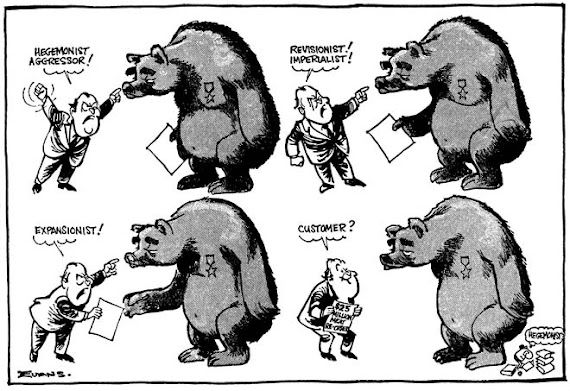
This cartoon was published by John Collins to show the stark ideological differences between the two superpowers.


Mr. Putin’s revisionist and absurd assertion that Ukraine was “entirely created by Russia” and effectively robbed from the Russian empire is fully in keeping with his warped worldview. Most disturbing to me: It was his attempt to establish the pretext for a full-scale invasion. 

Should he invade, it will be a historic error. 

In the 20-odd years since we met, Mr. Putin has charted his course by ditching democratic development for Stalin’s playbook. He has collected political and economic power for himself — co-opting or crushing potential competition — while pushing to re-establish a sphere of Russian dominance through parts of the former Soviet Union. Like other authoritarians, he equates his own well-being with that of the nation and opposition with treason. He is sure that Americans mirror both his cynicism and his lust for power and that in a world where everyone lies, he is under no obligation to tell the truth. Because he believes that the United States dominates its own region by force, he thinks Russia has the same right. 


Mr. Putin has for years sought to burnish his country’s international reputation, expand Russia’s military and economic might, weaken NATO and divide Europe (while driving a wedge between it and the United States). Ukraine features in all of that.Instead of paving Russia’s path to greatness, invading Ukraine would ensure Mr. Putin’s infamy by leaving his country diplomatically isolated, economically crippled and strategically vulnerable in the face of a stronger, more united Western alliance.

.......................................................................................................................................................................

Meanwhile, the great dragon of the East watches with interest. It's wide-awake and has been flexing its wings towards the Pacific.

Great Wall


Friday, December 10, 2021

№ 594. Our Facts, Our Truths and Our Reality

"Without facts, you can’t have truth. Without truth, you can’t have trust. Without trust, we have no shared reality, no democracy, and it becomes impossible to deal with the existential problems of our times: climate, coronavirus, now, the battle for truth." --- Maria Ressa, Nobel Laureate


Thursday, September 2, 2021

№ 582. The Snake Oil Theory of the Modern Right

Consider where we are right now in the fight against Covid-19. A few months ago it seemed likely that the development of effective vaccines would soon bring the pandemic to an end. Instead, it goes on, with hospitalizations closing in on their peak from last winter. This is partly due to the emergence of the highly contagious Delta variant, but it also crucially reflects the refusal of many Americans to take the vaccines.

And much of this refusal is political. True, many people who are refusing to get vaccinated aren’t Trumpists, but there’s a strong negative correlation between Donald Trump’s share of a county’s vote and vaccinations. As of July, 86 percent of self-identified Democrats said they had had a vaccine shot, but only 54 percent of Republicans did.

But vaccine refusers aren’t just rejecting lifesaving vaccines, they’re also turning to life-threatening alternatives. We’re seeing a surge in sales of — and poisoning by — ivermectin, which is usually used to deworm livestock but has recently been touted on social media and Fox News as a Covid cure.

Tuesday, April 14, 2020

№ 451. Nations of the World, Unite!

The Week


But the weakness of Washington should not prevent the brain trust of the developed world — the think tanks, news media, universities and nongovernmental organizations — from focusing on a strategy for the next and possibly most brutal front in the struggle against the scourge of the coronavirus. Many organizations have already begun to do so, recognizing that this may be the defining struggle of our era, and that if ever the world demanded a global response, this is it.

Wednesday, February 19, 2020

№ 440. The Pandemic of Xenophobia and Scapegoating


Societies facing novel pathogens have often engaged in scapegoating of marginalized populations, especially when the infective source can be linked to a distant place and the disease associated with a racially distinct “foreign” peoples. During the nineteenth century, rather than curtail commercial shipping, which ferried cholera around the globe, rattled cholera-stricken societies from New York to London turned their ire onto Irish immigrants instead. In 1832, a group of Irish immigrants, irrationally scorned as carriers, were first quarantined, and then secretly massacred and buried in a mass grave. Erroneously blamed for spreading HIV in the early 1980s, Haitians were beaten and harassed. Falsely scapegoated as carriers of SARS in 2003, Canadians of Chinese descent were kicked out of their homes and their businesses avoided.

Thursday, November 14, 2019

№ 425. The Social Media Coliseum

The philosophers Justin Tosi and Brandon Warmke have proposed the useful phrase moral grandstanding to describe what happens when people use moral talk to enhance their prestige in a public forum. Like a succession of orators speaking to a skeptical audience, each person strives to outdo previous speakers, leading to some common patterns. Grandstanders tend to “trump up moral charges, pile on in cases of public shaming, announce that anyone who disagrees with them is obviously wrong, or exaggerate emotional displays.” Nuance and truth are casualties in this competition to gain the approval of the audience. Grandstanders scrutinize every word spoken by their opponents—and sometimes even their friends—for the potential to evoke public outrage. Context collapses. The speaker’s intent is ignored.

Christoph Niemann

Sunday, August 18, 2019

№ 406. The F Word and the Orange Skull

Hail Hydra!

"A revealing story serendipitously showed up in my news feed this week. I learned that the billionaire chairman and former CEO of Marvel Entertainment, Isaac “Ike” Perlmutter, is a longtime friend of Donald Trump’s, an unofficial and influential adviser and a member of the president’s elite Mar-a-Lago club in Palm Beach, Florida. And Perlmutter and his wife have each recently donated $360,000 (the maximum allowed) to the Orange Skull’s “Trump Victory Joint Fundraising Committee” for 2020. I’ve also had to learn, yet again, that everything is political... just like Captain America socking Hitler on the jaw."